Request Validation
Learn about Request Validation in Express
1. Problem Statement
A Day at “BrightFuture University” Admissions
BrightFuture University’s admissions office is flooded with thousands of online applications every year.
-
Some students submit forms with missing grades or essays.
-
Others accidentally enter their birthdate as “202” or upload a selfie instead of a transcript.
-
Occasionally, a student’s application is processed even though their contact info is incomplete, making it impossible to send them an offer letter.
-
Sometimes, students are rejected for “missing documents” when they actually uploaded everything, but the system failed to check properly.
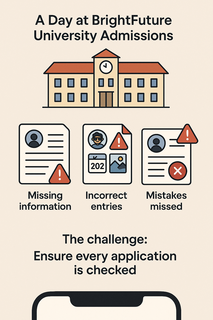
The challenge:
How do you ensure that every application is complete, accurate, and checked for mistakes before it’s processed-so no deserving student is lost, and no time is wasted on incomplete forms?
2. Learning Objectives
By the end of this lesson, you’ll be able to:
-
Understand the importance of request validation for data quality and fairness.
-
Use
express-validatororclass-validatorto enforce rules on incoming data. -
Provide clear, actionable feedback to users when their input is invalid.
-
Prevent downstream errors and confusion by catching mistakes early.
3. Concept Introduction with Analogy
Analogy: The University Admissions Desk
Imagine a real admissions desk:
-
Every application is checked by a staff member before it goes to the review committee.
-
If a transcript is missing, the staff immediately asks the student to provide it-no application moves forward until all requirements are met.
-
If a student writes their name in the “essay” field, the staff gently points out the mistake and helps them fix it.
-
Only complete, correct applications reach the decision-makers, ensuring a fair and efficient process.
Request validation in software is like this admissions desk: it ensures that every submission is checked for completeness and correctness before it enters the system.
A. Why Validate Requests?
-
Garbage In, Garbage Out: If you accept bad data, your system will produce bad results.
-
User Experience: Clear feedback helps users fix mistakes quickly.
-
Security: Prevents malicious or malformed data from causing issues.
-
Efficiency: Saves time by catching errors before they reach deeper parts of the system.
B. Validation with express-validator (Declarative, Middleware-Based)
-
Middleware approach: validation runs before your main logic.
-
Each rule checks a specific field and fails fast if something’s wrong.
C. Validation with class-validator (Decorator-Based, TypeScript/OOP Friendly)
-
Uses decorators on classes to define rules.
-
Great for projects using TypeScript and classes.
5. Step-by-Step Data Modeling & Code Walkthrough
Let’s walk through how “BrightFuture University” ensures every application is perfect before it’s reviewed:
A. Designing the Application Data Structure
Picture the chaos if applications were still paper forms: some missing essays, some with unreadable birthdates, and some with no contact info.
To fix this, the university creates a clear digital structure for every application-so nothing is forgotten, and every reviewer knows exactly what to expect.
 interface Application {
  name: string;
  email: string;
  birthdate: string;
  grades: number[];
  essay: string;
  recommendationLetter: string; // URL to a file
}
Explanation:
-
Every application must have a name, email, birthdate, grades, essay, and a link to a recommendation letter.
-
By making these fields required, the system ensures no application is missing crucial details.
B. Setting Up Validation Rules
Imagine the admissions staff with a checklist for every application:
-
Is the name filled in?
-
Is the email valid?
-
Is the birthdate a real date?
-
Are there grades for at least one subject?
-
Is the essay long enough?
-
Is the recommendation letter a real link?
We translate this checklist into code using express-validator:
 import { body, validationResult } from "express-validator";

const applicationValidation = [
  body("name")
    .isString()
    .notEmpty()
    .withMessage("Name is required"),
  body("email")
    .isEmail()
    .withMessage("Valid email is required"),
  body("birthdate")
    .isISO8601()
    .withMessage("Birthdate must be a valid date (YYYY-MM-DD)"),
  body("grades")
    .isArray({ min: 1 })
    .withMessage("At least one grade is required"),
  body("grades.*")
    .isNumeric()
    .withMessage("All grades must be numbers"),
  body("essay")
    .isLength({ min: 100 })
    .withMessage("Essay must be at least 100 characters"),
  body("recommendationLetter")
    .isURL()
    .withMessage("A valid recommendation letter link is required"),
];

  ```typescript

**Explanation:**

-   Each rule matches a real admissions requirement.

-   If any rule fails, the application is rejected with a specific message.


**C. Implementing the Route Handler**


Just like a staff member checking each application, our route handler reviews the checklist and gives instant feedback if anything is missing or wrong.

 ```typescript
 app.post("/apply", applicationValidation, (req, res) => {
  const errors = validationResult(req);
  if (!errors.isEmpty()) {
    // Return all validation errors
    return res.status(400).json({ errors: errors.array() });
  }
  // If we reach here, the application is valid!
  res.json({ status: "Application received!" });
});
Explanation:
-
validationResult(req)collects any problems found by the validation rules. -
If there are errors, the applicant gets a full list of what to fix-no more guessing.
-
Only applications that pass every check are accepted for review.
D. How This Solves the University’s Problems
-
No more missing essays or grades: The system blocks incomplete applications.
-
No more invalid emails or birthdates: Only real, usable contact info is accepted.
-
No more lost students: Every valid applicant gets a fair chance, and no one is rejected due to a system oversight.
-
Clear, actionable feedback: Students know exactly what to fix, reducing frustration and support requests.
E. Visualizing the Validation Flow
text
[Student submits application]  ↓ [Validation Middleware: Checks every field]
 ↓ [If errors: Respond with all problems]
 ↓ [If valid: Application accepted for review]
Example error response:
{
  "errors": [
    { "msg": "Valid email is required", "param": "email" },
    { "msg": "Essay must be at least 100 characters", "param": "essay" }
  ]
}
6. Interactive Challenge / Mini-Project
Your Turn!
-
Add a validation rule that requires a “portfolioLink” field to be a valid URL (for art applicants).
-
If missing or invalid, return an error message: “A valid portfolio link is required for art applicants.”
7. Common Pitfalls & Best Practices
| Pitfall | Best Practice |
|---|---|
| Only checking some fields | Validate every required field |
| Returning generic errors | Give specific, actionable feedback |
| Validating after business logic | Always validate first |
| Not handling arrays or nested data | Use grades.* or nested DTOs |
| Ignoring validation errors | Always check and return errors |
8. Quick Recap & Key Takeaways
-
Request validation is your first line of defense for data quality.
-
Use
express-validatororclass-validatorto enforce rules. -
Always validate before processing.
-
Give users clear feedback so they can fix mistakes.
-
A well-validated system is fairer, safer, and more efficient.
9. Optional: Programmer’s Workflow Checklist
-
Define all required fields and their types.
-
Use validation middleware before any business logic.
-
Return all validation errors in a friendly format.
-
Test with missing, invalid, and edge-case data.
-
Document validation rules for users and staff.
10. Coming up next
* Learn how to combine validation with authentication and authorization, so only the right people can submit or review applications!